
Energy in commercial real estate is often discussed through the lens of consumption, costs, and sustainability. For investors, however, the question is broader: can the way a property consumes, produces and stores energy make it more competitive, its cash flow more resilient and ultimately the asset more valuable?
We had a chat with Innovestor Real Estate Partner Tomi Asanti and Asset Manager Leo Pohjala about how energy performance can contribute to value creation – and why it needs to be considered as part of the broader investment case.
Energy performance in investment decisions
For a commercial property owner, energy is not simply another operating expense. The way a property consumes, produces and stores energy can influence its operating costs, its attractiveness to tenants and, ultimately, the quality of the cash flow it generates.
For Asanti, this means energy efficiency should be considered as part of the economics of the property rather than as a separate sustainability exercise. Energy-related investments need to create tangible value, whether through lower costs, greater competitiveness, or a stronger asset at the eventual exit.
Asanti captures the relationship simply: “The lease creates the base cash flow; energy creates additional value and options.”
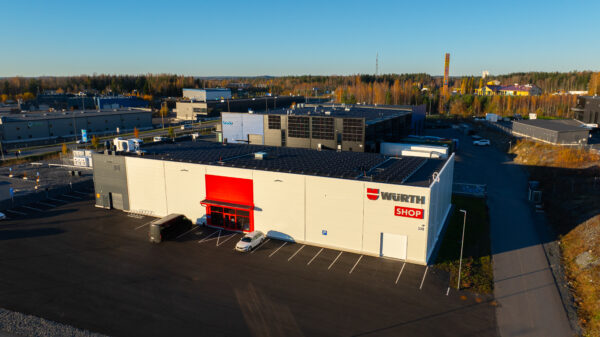
Würth’s new store in Pirkkala, completed in 2026, was built with rooftop solar panels and battery energy storage from the start. The neighbouring Tredu property in the background was retrofitted with solar panels on both the roof and the façade, as well as a battery storage system.
The cash flow impact of energy performance
A modern, energy-efficient property can offer more competitive operating costs. But energy performance is not necessarily fixed at the point of acquisition. It can also be actively developed during the ownership period. Solutions such as solar power and battery energy storage can provide tenants with more sustainable, potentially more affordable and more resilient energy.
Asanti sees the value coming from several smaller improvements rather than one single factor. A more energy-efficient property can become more attractive to tenants, support rents and help attract financially sound occupiers, ultimately strengthening the quality and resilience of the owner’s cash flow.
Innovestor’s properties in Pirkkala show how this approach can work both in a new development and an existing building.
Würth’s store, completed in 2026, was designed with 119 kWp of rooftop solar and a 1,290 kWh battery storage system from the outset. Because the building is heated entirely with electricity using an air-to-water heat pump, on-site generation and storage affect its entire energy bill, not just property electricity.
Next door, the Tredu property was retrofitted in 2025, during Innovestor’s ownership, with 290 kWp of solar on the roof and façade and a 2,795 kWh battery system. For tenants, one of the key benefits is predictability: on-site generation and storage allow Innovestor to offer competitively priced fixed-price electricity contracts, making energy costs easier to forecast.
For Pohjala, the Tredu property is a good example of what can be done with an existing building:
“Tredu shows that an existing building doesn’t have to stay as it is. In 2025 we added solar on the roof and façade and a battery system without disrupting the tenant’s operations, and we can now offer the tenant cost-efficient, locally produced electricity.”
The battery systems also serve a purpose beyond storing locally generated solar power. In Finland, solar production and energy demand do not necessarily peak at the same time, particularly in electrically heated buildings.
“In Finland, solar production peaks in summer, while an electrically heated building uses most of its energy in winter. That’s where the battery earns its place: it cuts peak loads and takes part in Fingrid’s reserve markets all year round,” Pohjala explains.
Energy performance is, however, an enhancement rather than a substitute for strong real estate fundamentals. A poor location or weak tenant demand cannot be solved through energy investments alone.
Value creation through active ownership
Energy therefore becomes part of active ownership. Consumption, on-site generation and storage can all be developed during the investment period rather than simply accepted as fixed characteristics of the asset.
This matters not only during ownership but also at exit. A future buyer will assess the property’s ability to generate sustainable cash flow, making its operating economics and long-term competitiveness part of the value equation.
A recent example is Innovestor’s November 2025 sale of four fully let retail properties in Lohja, Nurmijärvi, Järvenpää and Hämeenlinna to Prisma Properties, at an underlying property value of approximately EUR 24 million. The properties combined strong retail fundamentals and tenants mainly in discount retail with integrated solar and battery storage solutions developed by Innovestor. In announcing the transaction, Prisma highlighted the properties as modern and energy-efficient assets that meet the high demands of the retail sector.
For Pohjala, the energy solutions were one part of the broader investment case and contributed to the properties’ competitiveness.
“A buyer is ultimately acquiring a cash flow and its resilience. The solar and battery systems were part of what made these assets modern and competitive, especially for a buyer focused on energy-efficient retail properties.”